Abstract
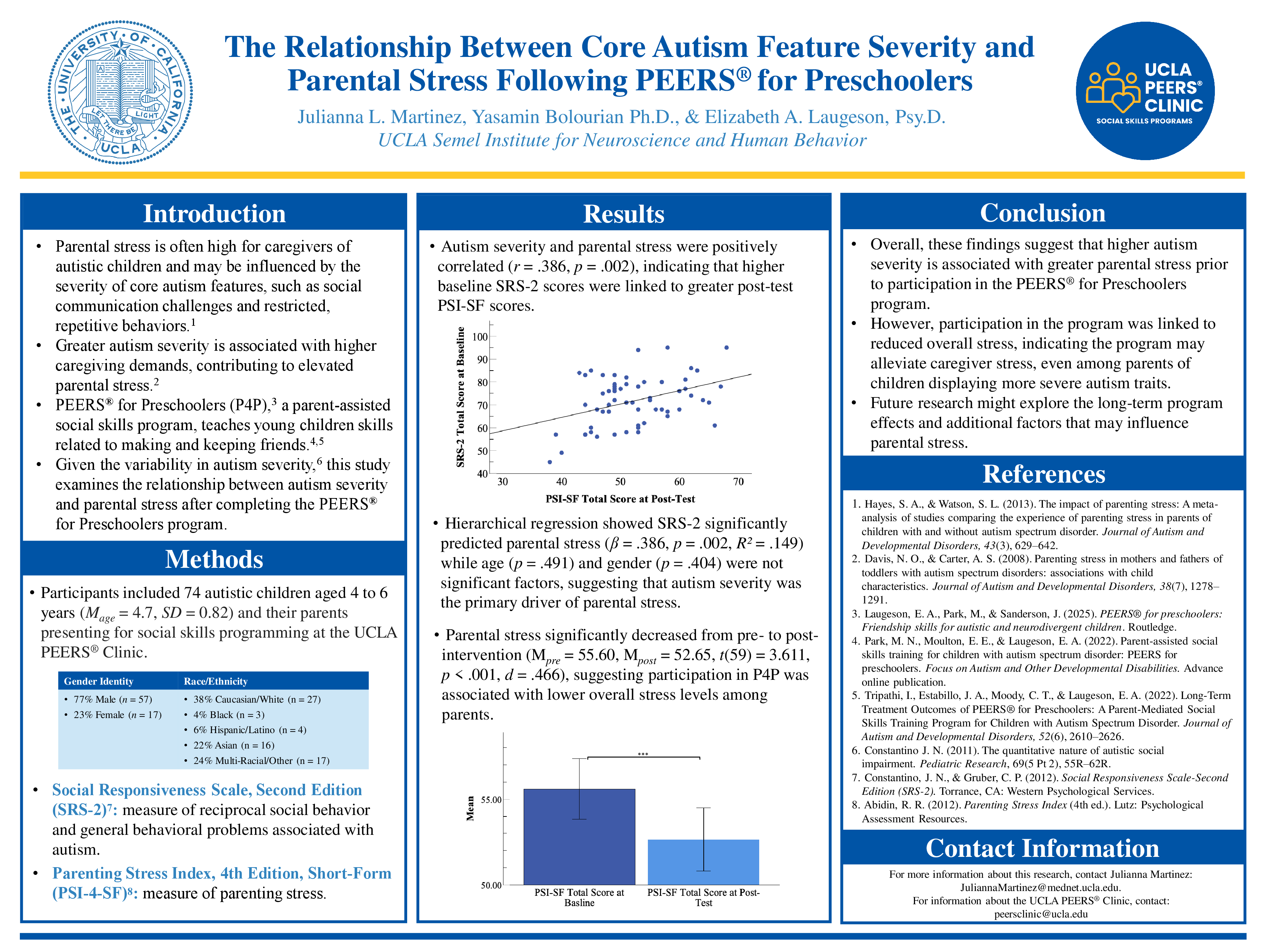
Background: Parental stress is often high for caregivers of autistic children and influenced by the severity of core autism features, such as social communication challenges and restricted, repetitive behaviors (Hayes & Watson, 2013). Greater autism severity is associated with higher caregiving demands, contributing to elevated parental stress (Davis & Carter, 2008). PEERS® for Preschoolers, a parent-assisted social skills program, teaches young children skills related to making and keeping friends (Park et al., 2022; Tripathi et al., 2021). Given the variability in autism severity (Constantino, 2011), this study examines the relationship between autism severity and parental stress after completing the PEERS® for Preschoolers program.
Methods: Participants were 107 preschool-aged children (Mage = 4.79, SD = 0.88) and their parents who completed PEERS® for Preschoolers. The Social Responsiveness Scale, Second Edition (SRS-2) was used to measure autism severity and the Parenting Stress Index-Short Form (PSI-SF) to assess parental stress post-program. Demographic variables, including child age and gender, were included as covariates. A Pearson correlation examined autism severity and parental stress. A hierarchical linear regression assessed whether SRS-2 total scores predicted PSI-SF post-program scores after controlling for child age and gender.
Results: Pearson correlation revealed a significant positive association between SRS-2 at baseline and PSI-SF at post-test (r = .386, p = .002), indicating that greater autism symptom severity was linked to higher parental stress following PEERS® for Preschoolers. A hierarchical regression showed that SRS-2 significantly predicted PSI-SF (β = .386, p = .002, R² = .149) but neither child age (p = .491) nor gender (p = .404) contributed additional variance, suggesting that autism severity was the primary driver of parental stress. A paired-samples t-test indicated a significant reduction in parental stress from pre- to post-program (Mpre = 55.60, Mpost = 52.65, t(59) = 3.611, p < .001, d = .466), demonstrating that, despite the relationship between autism severity and parental stress, participation in PEERS® for Preschoolers was associated with lower overall stress levels among parents.
Conclusion: The findings suggest that higher autism severity is associated with greater parental stress following participation in the PEERS® for Preschoolers program. However, participation in the program was linked to reduced overall stress, indicating the program may alleviate caregiver stress, even among parents of children displaying more severe autism traits. Future research might explore the long-term program effects and additional factors that may influence parental stress.