Abstract
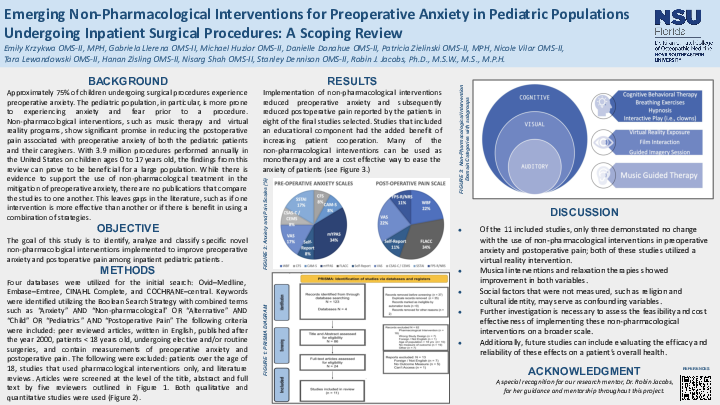
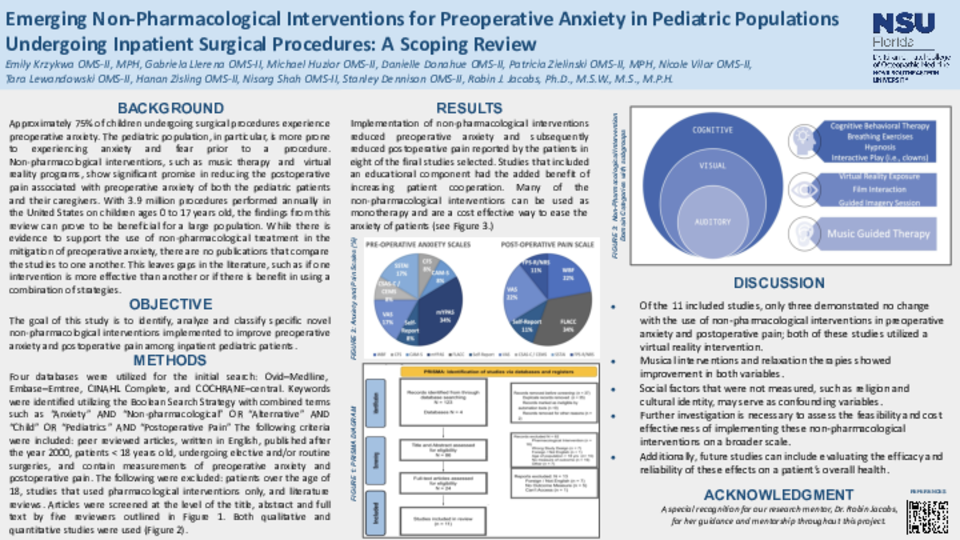
Background: Approximately 75% of children undergoing surgical procedures experience preoperative anxiety. The pediatric population, in particular, is more prone to experiencing anxiety and fear prior to a procedure. Non-pharmaceutical interventions, such as music therapy and virtual reality programs, show significant promise in reducing the post operative pain associated with preoperative anxiety of both the patients and their caregivers. With 3.9 million procedures performed annually in the United States on children ages 0 to 17 years old, the findings from this review can prove to be beneficial for a large population. While there is evidence to support the use of non-pharmaceutical treatment in the mitigation of pre-operative anxiety, there are no publications that compare the studies to one another. This leaves gaps in the literature, such as if one intervention is more effective than another or if there is benefit in using a combination of strategies.
Objective: The goal of this study is to identify, analyze and classify specific non-pharmacological interventions utilized in-patient among children to improve preoperative anxiety and postoperative complications inflicting pain.
Methods: Comprehensive searches were conducted utilizing the databases Ovid – Medline, Embase – Emtree, CINAHL Complete, and COCHRANE – central. These databases were chosen due to their reliability and comprehensiveness. To be included in the scoping review, the articles had to be peer reviewed, written in English, published after the year 2000, and contain measurements of preoperative anxiety and postoperative pain. Both qualitative and quantitative studies were used. We focused on selecting articles that collected data on patients younger than 18 years of age undergoing elective and/or routine surgeries, excluding emergent surgical cases. Other exclusion criteria included studies of patients over the age of 18 and studies that used pharmacological interventions only. Articles were screened at the level of the title and abstract and full text by 5 five reviewers.
Results: A total of 126 articles were initially uploaded from the original data search utilizing 4 databases. A total of 85 articles were screened at the title and abstract level, of which 24 were also assessed at full text for eligibility. There was a total of 10 articles selected from 8 different journals. Studies originated from global academic centers with the predominant discipline of the first author being that of internal medicine. Studies showed that non-pharmacological interventions such virtual reality, hypnosis, and clowns reduced preoperative anxiety and post operative pain.
Conclusion: In conclusion of this review, there is clear paucity in the current literature on reducing preoperative anxiety in relation to post-operative pain in pediatric populations. The scoping review identified a wide range of non-pharmacological interventions to mitigate the post operative effects of pre-operative anxiety among children including but not limited to music, visual reality, and other holistic methods. More studies are warranted to understand the specific interventions that may be superior to others in a longitudinal approach.